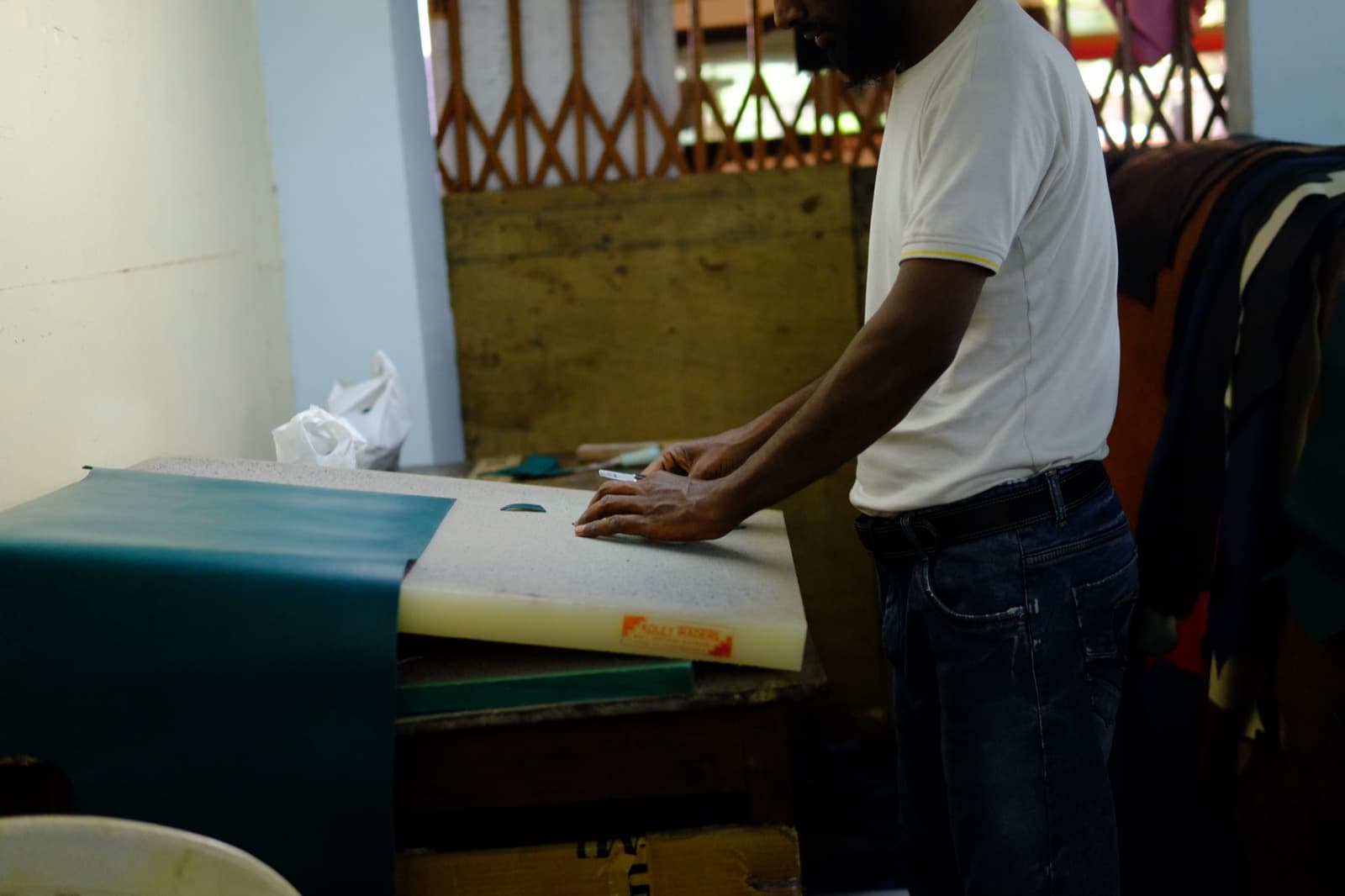
To find a bag manufacturer, start with a clear brief — a sketch or tech pack, a target price, a quantity and a timeline. Build a long list from directories, trade fairs, fair-trade networks, referrals and targeted Google searches, then shortlist three to five and vet them on samples, communication and audits before you pay for anything in bulk. This guide covers each step, with a checklist you can use on calls.
We're MKS Exports, a leather bag and accessories manufacturer in Kolkata, India, so we're not a neutral party. We've tried to write the guide we'd want a founder to read before contacting any factory, including us.
Before you search: prepare four things
Manufacturers triage enquiries. A message that says 'I want to make bags, how much?' tends to get a slow or generic reply. One that answers these four questions gets a real quote.
- What you want made. A tech pack is ideal. A clear sketch with dimensions, or a reference bag you can photograph or post, is enough for most workshops to start. Note the main material (full-grain leather, canvas, jute), the hardware and how you want your brand shown.
- Your target price. Give an ex-factory or landed target per unit, so the factory can tell you early whether the leather and construction you want fit it. Hiding your budget wastes time on both sides.
- Your quantity. Per style, and per colour if you want more than one. If it's a small batch of 50 to 100 pieces, say so — factories that work at that scale will be glad to hear it, and those that don't will tell you quickly.
- Your timeline. When you need a sample, and when stock must arrive. Work backwards: sampling, revisions, production and freight each take weeks, not days.
If you don't have a tech pack yet, our guide to bag tech packs explains what goes in one. You don't need it to start conversations, but you will need its contents agreed before bulk production.
Where to look
- B2B directories. Alibaba and IndiaMART list thousands of suppliers; Maker's Row focuses on US makers. They're good for range and poor at signalling quality — a listing tells you who registered or paid, not who is good. Many listings are trading companies rather than factories.
- Trade fairs. Handling a supplier's products in person is still one of the fastest ways to judge quality. Leather fairs such as the India International Leather Fair in Chennai, or MIPEL in Milan for bags, put many makers in one hall; materials fairs such as Lineapelle are useful for meeting tanneries and component suppliers. Check current dates and exhibitor lists before you book travel.
- Export promotion bodies. In India, the Council for Leather Exports keeps a directory of member exporters you can search by product.
- Fair-trade and ethical networks. If ethics are part of your brand, fair-trade organisations and ethical sourcing platforms list producer members who have already been through some form of verification. It's a smaller pool, but a pre-filtered one.
- Referrals. Ask brands of a similar size to yours, or a pattern maker, designer or sourcing agent who has worked with bag factories. A referral from a brand at your scale is the best lead you'll get.
- Google, with modifiers. Search the product, material and place together — 'leather tote bag manufacturer India', 'custom bag manufacturer Kolkata', 'low MOQ backpack manufacturer'. Then check each site for a physical address, photos of a real workshop and named clients.
- Reddit and forums. Threads like 'how to find a manufacturer of handbags' are useful for warnings and questions to ask. But many replies are factories pitching themselves. Treat recommendations there as leads to vet, not endorsements.
Factory, trading company or agent?
Know who you're talking to. A factory makes the product in its own workshop. A trading company takes your order and places it with one or more factories. A sourcing agent works for you, for a fee or commission, to find and manage factories. All three can work. A trading company can be useful for mixed orders across product types, but it adds a margin and a layer between you and the people making your bag — and that layer is often where communication breaks down. Ask directly: 'Do you own the facility where my bags will be made?' Then ask to see it on video.
How to vet a bag manufacturer: a checklist
Shortlist three to five manufacturers and run each through the same checks. Keep notes in one spreadsheet so you're comparing like with like.
- Reply speed and clarity. Note how long each takes to answer, and whether they answer the question you actually asked. 'Great sample, poor communication' is the complaint that comes up again and again in founder threads, and it rarely improves once a deposit is paid.
- Questions back to you. A good manufacturer asks about leather, hardware, edge finish, target price and how the bag will be used. A factory that quotes instantly on a vague brief is guessing.
- A sample of your design. Not just their catalogue pieces. Check that stitching is straight and even with no loose ends, edges are smooth and consistent, the two sides are symmetrical, the lining sits flat, hardware is firmly attached, and the leather feels and smells right.
- Portfolio and references. Ask which brands they make for and whether you can speak to one. Long relationships say more than famous names — a client that has stayed for ten years has had plenty of chances to leave.
- Audits and certifications. Ask for reports, not logos. Social compliance audits such as Sedex SMETA or amfori BSCI cover labour standards, wages, health and safety; ISO 9001 covers quality management. For leather, ask where it is tanned: Leather Working Group (LWG) audits apply to tanneries, so the useful question for a bag maker is which audited tanneries supply them.
- A live video walk-through or visit. Ask to see cutting, stitching, edge finishing and quality control. A pre-recorded video is a fine first step; a live call is better, because you can ask to see a specific station.
- A clear quote. Price per unit at your quantity, what's included (branding, labels, packaging), sample charges, lead time and shipping terms such as FOB. Ask what would change the price, up or down.
- A small first order. Start at or near the minimum order quantity, and check the bulk against the approved sample before you scale.
Red flags
- A price far below everyone else's for the same specification. Something is being cut — the leather grade, the labour or the compliance.
- No questions about your design, materials or use.
- A showroom tour but no production floor, or reluctance to show the workshop on video.
- Product photos that also appear on other suppliers' sites. A reverse image search takes a minute.
- Pressure to pay everything up front, or bank details in a name that doesn't match the company you're contracting with.
- Audit 'certificates' with no report, date or audit reference.
- A great sample, but no clear answer on whether bulk will use the same leather and hardware.
How sampling turns into bulk production
The exact steps vary by factory, but most custom bag development follows this sequence:
- Enquiry and indicative quote. You share the brief; the factory gives a price range and its minimum order quantity (MOQ).
- Pattern and prototype. The factory makes a pattern and a first sample. Expect one or two rounds of changes.
- Materials and colour approval. You sign off leather swatches, lining, thread, hardware finish and logo method.
- Pre-production sample. A final sample made with bulk materials. Once both sides sign it off, it's the standard the order is checked against, so keep one each.
- Purchase order and deposit. Payment terms vary by manufacturer; a deposit before production and the balance before shipment is a common structure.
- Production. Ask for photos at cutting, stitching and finishing so problems are caught early.
- Final inspection. You, an agent or a third-party inspector check finished goods against the approved sample, often using an AQL sampling plan.
- Shipping. Under FOB terms the manufacturer delivers to the port of export, and you or your freight forwarder handle freight, import duties and delivery from there.
Why India, and why Kolkata?
India has a large, long-established leather industry with its own tanneries, which keeps the chain from hide to finished bag short. Its leather cities specialise: Kolkata is known for leather bags and small leather goods, while clusters in Tamil Nadu, Kanpur and Agra lean more towards finished leather, footwear and saddlery. Kolkata also has a strong textile craft tradition — kantha, jute, block printing — which suits brands that mix leather with fabric.
Indian manufacturers tend to suit brands that want real leather, hand-finished details and smaller runs. They're not the answer to everything. If your bag is highly technical — nylon backpacks with moulded panels, taped waterproof zips and complex hardware — factories in China or Vietnam with deep synthetic-materials supply chains may serve you better. If 'made in Europe' is part of your positioning, workshops in Italy, Spain or Portugal make sense, at a higher price. Choose the region that fits the bag.
In short
Prepare a clear brief, search widely and shortlist narrowly, then judge each manufacturer on what it does before you pay: how it communicates, what its sample is like, and what it is willing to show you. If you'd like us on your shortlist, send a sketch or tech pack and we'll come back to you within 24 hours.